Yosemite West Property & |
100 Feet of Defensible Space is the Law
| Mission of the YWPHI Fire Safety Committee |
|---|
The mission of the YWPHI Fire Safety Committee is to preserve Yosemite West's natural and built resources by educating and mobilizing all property owners to make their houses, lots and the community Fire Safe. The YWPHI Fire Safety Committee does not fight fires nor enforce any laws or regulations. The YWPHI Fire Safety Committee seeks to communicate and cooperate with County, State and Federal agencies whose mission is fire protection and public safety. |
In June 2008, Yosemite West became the first Mariposa County community to complete a Community Wildfire Protection Plan (CWPP), a four-year long process initiated by NPS and completed through two grants awarded to YWPHI with funding provided by a National Fire Plan grant from the National Park Service through the California Fire Safe Council. Implementation of the prioritized projects in the CWPP has continued with nine grants totaling more than $840,000, which were secured by YWPHI for the benefit of the entire community.
Extensive logging during the early decades of the twentieth century and subsequent fire suppression in the Yosemite West area have lead to a more or less even-aged stand of mixed conifers, an accumulation of forest fuels on the ground, and an increase in tree stand density. As a result, the forest has changed from one that was once adapted to wildland fire to one that is more prone to catastrophic wildfires. When Yosemite West was first developed in 1967, only trees in the roads' right-of-way were removed from a then 45-year-old forest. Today's mixed conifer forest is now almost 100 years old and in its natural condition should contain only about one quarter of the number of trees currently present with white fir and incense cedar constituting a much lower percentage of the total stand with much less undergrowth due to periodic surface fires.
Under the right set of conditions, Yosemite West is susceptible to a large-scale, stand-replacing wildfire that is capable of consuming all in its path. A wildland fire of the magnitude experienced during the 1990 A-Rock and Steamboat fires could place firefighters and the public at risk and destroy public and private property.
| How to Make Yosemite West a Fire Safe Community | |
|---|---|
Read >> What residents can do
|
Read >> What YWPHI is doing
|
Certain private property owners within Yosemite West are actively practicing the mitigation measures recommended by Fire Safe. Other private property owners, however, have taken little or no action to protect their properties from wildland fire. The inconsistent application of Fire Safe mitigation measures places the entire community at an increased risk from wildfires.
Take the Yosemite West Defensible Space Reality Check
A Red Zone Fire Risk Assessment conducted by the Mariposa County Fire Department in 2004 and repeated in 2008 and 2009 shows that only 40% of structures are in the target zone with 60% of structures in undesirable high-risk zones. The community is working on a grassroots level to inform homeowners about PRC§4291 and facilitate compliance, yet no legal mechanism or ordinance exists to enforce fuels treatment on vacant lots within the community.
The start of fire season in Yosemite is historically between June 10th and 13th, although it is not any predefined date. Each year the determination is made based on a combination of factors such as winter precipitation, current and predicted weather for the early part of the season, and fuel moistures in indicator species. Even in years with high percentage of snow pack and fuel moistures at all elevations, fire season is likely to start about the same time.
For general purposes, you can consider it be fire season when there is no snow on the ground and it's not wet.
Recent starting dates are:
Technically, NPS determines the closure of fire season when a season-ending precipitation event totaling two inches or more occurs. Historically, there is a 90% chance that Yosemite will have a season-ending weather event by October 31.
Recent closing dates are:
Download the Yosemite West Community Wildfire Protection Plan, which was approved by the Mariposa County Board of Supervisors in June 2008.
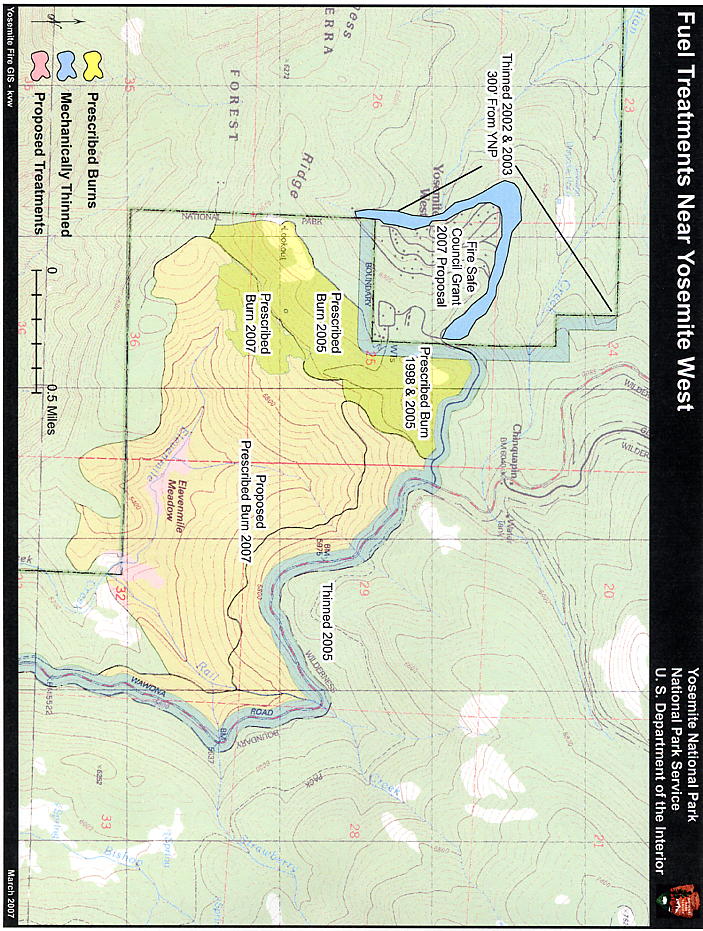
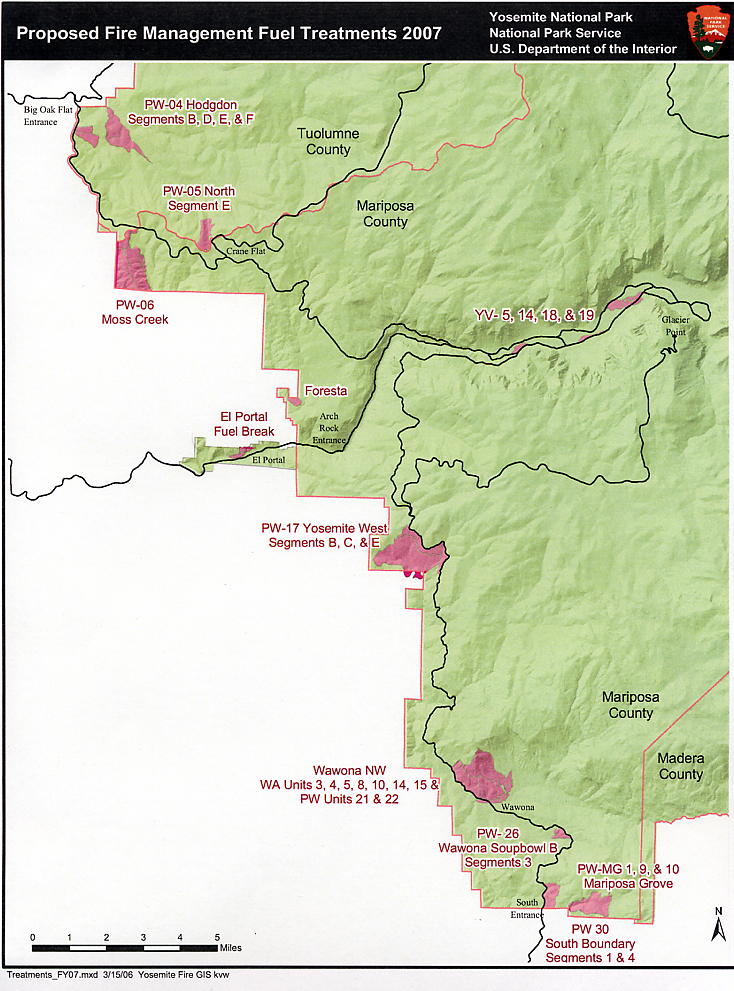
Two reference maps, not included in the CWPP, are:
 Copyright text © Yosemite West Property & Homeowners, Inc. 2003-2017. Copyright photographs © John Mock 2004-2017. All rights reserved. Unauthorized redistribution of this document is prohibited. Updated December 28, 2016. |